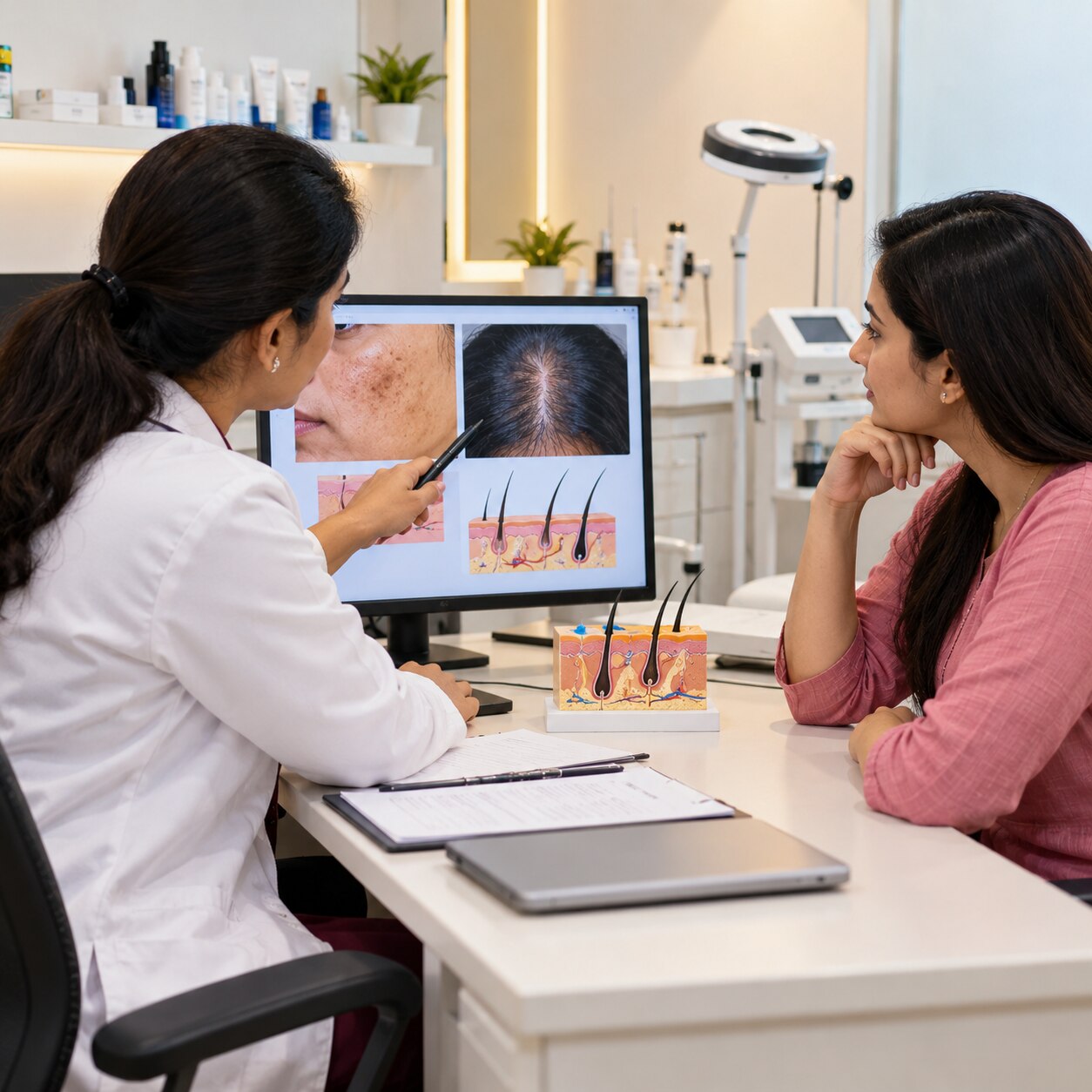
A polished clinic website cannot tell you whether the named practitioner can diagnose your problem, whether a recommended procedure is suitable, or how complications will be handled. Use the consultation, treatment plan, safety checks and follow-up arrangements to decide whether a clinic deserves your trust—or whether you should keep looking.
Key takeaways
- Verify the clinician’s registration, dermatology qualification and treatment-specific training.
- Request a written diagnosis and itemised treatment plan before paying.
- Check infection-control procedures, product licences and emergency arrangements.
- Assess hair-loss treatment using diagnosis, donor supply, timeline and follow-up.
Verify the clinician and insist on a diagnosis before treatment
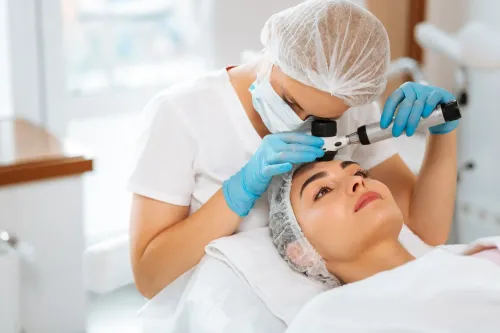
Do not pay for a package before an in-person consultation with the named clinician. Check the dermatologist credentials: medical registration number, dermatology qualification and treatment-specific training. Ask who will examine you and who will perform each injection, laser treatment, PRP, GFC session or transplant.
The consultation should record your medical history, medicines, allergies, pregnancy status, previous procedures, skin examination and photographs. Ask, “What diagnosis are you considering, and which examination supports it?” A clinician who cannot answer should not sell you a procedure.
| Concern | Diagnosis to distinguish | Why it changes treatment |
|---|---|---|
| Acne, pigmentation or scarring | Active acne, tanning, darker skin phototype or previous post-inflammatory hyperpigmentation | Peels, lasers and scar procedures can worsen inflammation or pigmentation |
| Hair shedding | Pattern hair loss, telogen effluvium, alopecia areata, traction alopecia or scarring alopecia | PRP, GFC and transplantation are not interchangeable; transplanting during active scarring inflammation can worsen permanent loss |
| Unclear or complex problem | A condition outside the clinician’s scope | You need referral to a dermatologist, hair-transplant surgeon, plastic surgeon or another relevant specialist |
Ask whether the clinic refers cases it cannot diagnose instead of defaulting to a sale. Request the clinician’s name and qualifications on your records, not merely the clinic’s branding.
Compare complete treatment plans, not headline prices
Compare the diagnosis and expected benefit before comparing prices. A proper treatment comparison covers the full course, not one session.
| Factor | Ask both clinics to state | Why it matters |
|---|---|---|
| Diagnosis and benefit | Condition being treated and realistic improvement | Different diagnoses need different treatments |
| Course | Sessions, interval and review date | A cheaper session may require more visits |
| Risk and upkeep | Downtime, side effects and maintenance treatments | Recovery and future treatment affect the result |
| Cost | Total estimated cost, including medicines and follow-ups | The headline price can hide the real expense |
Request a written treatment plan naming:
- Procedure, product or device and treatment area
- Dose or device settings, where relevant
- Session schedule, aftercare instructions and review date
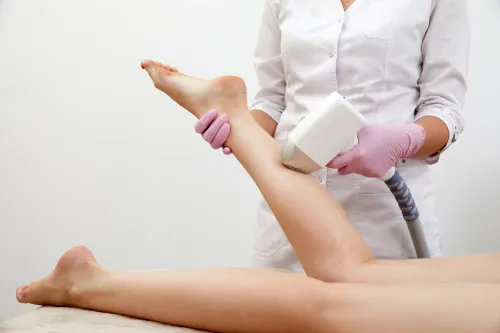
Ask whether medicine, observation or a less invasive option could work. For laser or light treatment, ask how your skin phototype, tanning status, the device’s indication, operator experience and a test spot affect the recommendation. Darker or recently tanned skin can face greater burn or pigmentation risk.
For aesthetic and anti-ageing care, ask about reversibility, risks, downtime, maintenance and non-procedure alternatives; normal ageing is not automatically a medical defect. Add consultation time, preparation, sun protection, medication adherence, travel and future maintenance to the cost. Do not buy a package until you know what happens if it is unsuitable or incomplete.
Inspect infection control, products and emergency arrangements
Before any injection, procedure or hair treatment, inspect the treatment area and the materials. Look for cleaned surfaces, sealed sterile disposables and a sharps container. Ask staff to open products in front of you and show the manufacturer, exact product name, batch number and expiry date, storage conditions, and authorisation for the intended use.
| Check | Ask for | Consequence of a weak answer |
|---|---|---|
| Routine treatment | Infection control process, practitioner identity and written consent naming the treatment and material risks | Poor traceability and preventable exposure |
| Dermal filler | Vascular occlusion management, emergency medicines, injector training and escalation plan | Delayed treatment can cause skin necrosis, stroke or blindness |
| Elective surgery | Operating facility, anaesthesia provider, trained staff, accreditation or licensing and emergency-transfer plan | A consultation room is not proof of hospital-level capability |
Confirm who handles complications after hours, where urgent review occurs, and whether follow-up is included. Ask how complications, revisions and adverse reactions are recorded. Seek immediate help for severe or worsening pain, pale or dusky skin, vision changes, weakness, breathing difficulty or heavy bleeding.
Walk away if staff refuse to identify the practitioner, show the product, explain risks or provide urgent follow-up.
Evaluate hair-loss treatment around diagnosis, donor supply and time
Choose observation, medicines, PRP, GFC or transplantation only after a hair-loss diagnosis identifies the cause. Ask whether the clinician has assessed shedding, patterned loss, alopecia areata, scalp disease, nutritional or hormonal causes, and scarring alopecia.
| Option | Main role | Questions and limits |
|---|---|---|
| Observation | Monitor stable or temporary shedding | What finding supports waiting, and when is review due? |
| Medicines | Treat suitable patterned loss or support regrowth | Minoxidil requires continued use and can irritate the scalp; finasteride is not suitable for everyone. Discuss sexual adverse effects and pregnancy exposure from crushed tablets. |
| PRP versus GFC | Injections proposed for selected cases | Ask what evidence supports the recommendation, how many sessions are planned and how results will be measured. |
| Transplantation | Redistribute existing follicles | It cannot create unlimited hair and is unsuitable during active scarring inflammation, which can worsen permanent loss. |
For surgery, compare FUE versus FUT, the proposed graft number, donor-area limits, extraction and implantation plan, recovery and the time needed to judge results. Confirm who extracts and implants grafts, and whether a doctor performs the procedure. Ask how the plan protects against overharvesting and visible donor depletion while accounting for future loss.
“Natural-looking” should mean a planned hairline, appropriate graft direction, realistic density and a future-loss strategy—not a guarantee.
Test the clinic’s evidence and judge whether its claims fit you
Before-and-after photographs become meaningful only when the comparison is standardised and the outcome is reported honestly. Request images with consistent lighting, camera distance, pose, facial expression, hair length and time after treatment.
Ask whether they are unedited, whether the patients had comparable skin or hair conditions, and whether they represent typical results rather than selected cases.
Ask these questions before trusting the clinic’s claims:
- How many patients experience complications, revisions or dissatisfied results?
- Do representative testimonials name the treatment, number of sessions, recovery and follow-up?
- What does personalised treatment change in measurable terms: settings, dose, graft plan or session interval?
| Concern | Ask what changes the plan | Evidence of realistic results |
|---|---|---|
| Acne | Active disease, skin type and scarring risk? | Control active acne before treating scars |
| Pigmentation | Sun exposure, skin type and post-inflammatory hyperpigmentation risk? | Conservative settings or a test spot when appropriate |
| Aesthetic procedure | What improves, and what remains unchanged? | Clear limits, maintenance and risks |
A selected photograph proves what happened to one person, not what will happen to you. Guaranteed results, immediate-sales pressure, unedited social-media claims and testimonials without treatment details are warning signs. Seek a second opinion if the clinic refuses to discuss alternatives, risks or maintenance.
Confirm specialist referrals, continuity and the practical effort of care
After consultation, choose the clinic that explains the complete care pathway, not just the procedure. Ask which clinician manages problems outside dermatology, whether a specialist referral is arranged, and where it occurs. Hair-transplant surgery may need a restoration surgeon; suspicious lesions, complex scars and reconstruction may need plastic surgery.
Rectal bleeding needs assessment before any haemorrhoid procedure, while suspected varicose-vein disease needs duplex ultrasound before treatment planning.
- Ask who handles complications outside office hours, where urgent review takes place, and who can access operative records, pathology reports or imaging.
- Confirm the follow-up arrangements and whether reviews, dressings, medicines or complication management are included in the quoted price.
- Check clinic accessibility: the exact branch, appointment process, parking, public transport and the contact route for follow-up.
| Care pathway | What to confirm | Warning sign |
|---|---|---|
| Hair transplant | Restoration surgeon, graft plan and surgical responsibility | Sales consultation without diagnosis |
| Rectal bleeding | Medical assessment and referral pathway | Automatic haemorrhoid treatment |
| Varicose veins | Duplex ultrasound and vascular treatment plan | Procedure offered without imaging |
For readers comparing Skinzone Clinic-Skin, Hair & Aesthetic Clinic Pune, confirm whether you need the Bibwewadi branch at Skin Zone & Spire Hospital, Ganesh Market, Bibwewadi Kondhwa Road, near Aai Mata Chowk, or Pawar Hospital, Pune-Satara Road, Dhankawadi. Verify the branch and appointment details at 09028717979.
Frequently asked questions
What credentials should you check before choosing a skin clinic?
Ask for the clinician’s medical registration number, dermatology qualification and treatment-specific training. Confirm who will examine you and perform each procedure.
Why should you compare complete treatment plans instead of prices?
Compare the diagnosis, number of sessions, products, aftercare, follow-up visits and possible additional costs rather than choosing by headline price.
What safety standards should a skin clinic have?
Inspect hand hygiene, sterile or single-use equipment, product batch details, storage practices and the clinic’s arrangements for handling complications or emergencies.
How should you evaluate hair-loss treatment?
Require a diagnosis, assess donor hair supply, clarify the expected timeline and confirm who will provide follow-up care.
What evidence should a clinic provide for its treatment claims?
Ask what condition the treatment addresses, what evidence supports it, what results are realistic for you and which risks or alternatives apply.